
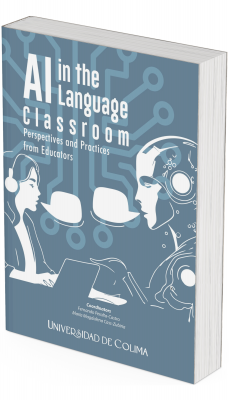
AI in the Language Classroom: Perspectives and Practices from Educators
Palabras clave:
Inteligencia Artificial, educación, aula de idiomas, profesoradoSinopsis
La Inteligencia Artificial (IA), un agente transformador que ha irrumpido en nuestra vida cotidiana y se ha convertido en un cambio fundamental en nuestra forma de vivir, trabajar e interactuar, es también conocida como el núcleo de la cuarta revolución industrial, ya que funciona como una entidad que integra otras tecnologías. A pesar de su experiencia en educación, la IA sigue siendo un campo fértil, especialmente en el área de la enseñanza y el aprendizaje de idiomas. Este libro explora cómo la IA ha permeado la vida académica de los docentes de idiomas en diversos contextos universitarios de la República Mexicana. Las diferentes posiciones geográficas representadas por cada uno de los investigadores participantes revelan una característica distintiva de este proyecto: la diversificación de las fuentes de información, lo que permite comprender el tema y profundizar en él desde la perspectiva y la experiencia de personas diversas en diferentes contextos educativos.
Descargas
Referencias
Al-Anezi, Y. H., & Alajmi, S. M. (2021). Factors That Influence English Teachers' Acceptance and Use of E-Learning Technologies. International Education Studies, 14(9), 15-27. https://doi.org/10.5539/ies.v14n9p15
Alhalangy, A., & AbdAlgane, M. (2023). Exploring the impact of AI on the EFL context: A case study of Saudi universities. Journal of Intercultural Communication, 23(2), 41-49. https://doi.org/10.36923/jicc.v23i2.125
Al-Othman, A. A. M. (2024). Using Artificial Intelligence in English As A Foreign Language Classrooms: Ethical Concerns and Future Prospects. Arab World English Journal, 10, 85-104. https://doi.org/10.24093/awej/call10.7
An, X., Chai, C. S., Li, Y., Zhou, Y., Shen, X., Zheng, C., & Chen, M. (2022). Modeling English teachers' behavioral intention to use artificial intelligence in middle schools. Education And Information Technologies, 28(5), 5187-5208. https://doi.org/10.1007/s10639-022-11286-z
Arif, T. Z. Z. A., & Handayani, R. (2021). Factors Influencing the Use of ICT for English Language Learning of Indonesian EFL University Students. ELSYA Journal of English Language Studies, 4(1), 24-33. https://doi.org/10.31849/elsya.v4i1.6882
Jamali, A., Khoumbhati, K., Shah, A., Bhutto, A., & Jamali, A. (2024). Exploring ICT-based learning adoption in higher education: An extended perspective of the technology acceptance model. Mehran University Research Journal of Engineering and Technology, 43(3), 89-101. https://doi.org/10.22581/muet1982.3069
Australian Government Department of Education. (2024, May 03). Building an understanding of AI in education. Retrieved from Organisation for Economic Co-operation and Development.
Benek, K. (2025). EFL learners' and teachers' perceptions of ai-powered language learning technologies: Benefits and challenges. International Journal of Instruction, 18(2), 103-120. https://doi.org/10.29333/iji.2025.1827a
Belda-Medina, J., & Calvo-Ferrer, J. R. (2022). Integrating augmented reality in language learning: pre-service teachers' digital competence and attitudes through the TPACK framework. Education and Information Technologies, 27(9), 12123-12146. https://doi.org/10.1007/s10639-022-11123-3
Bergin, T. (2018). An introduction to data analysis: Quantitative, qualitative and mixed methods. Sage Publications. https://doi.org/10.4135/9781529682854
Burns, M. (2023). Technology in education. Paper commissioned for the Background paper prepared for the 2023 Global Education Monitoring Report. UNESCO.
Chang, A., Jau, A., & Bujeng, B. (2024). Exploring Perception of Trainee Teachers at the Malaysian Institute of Teacher Education towards Chatbot-Based Artificial Intelligence: ChatGPT. Progress in Computers and Learning, 1(1), 36-46. https://doi.org/10.37934/picl.1.1.3646
Chakim, N., Iswati, H. D., & Lolita, Y. (2023). Pre-Service EFL Teachers' Knowledge and Practices of TPACK at Edu-Tech Classrooms: Preparation for Real-Teaching Practices. In Advances in Social Science, Education and Humanities Research/Advances in social science, education and humanities research. 576-596. https://doi.org/10.2991/978-2-38476-152-4_54
Chen, L., Chen, P., & Lin, Z. (2020). Artificial intelligence in education: A review. IEEE Access, 8, 75264-75278. https://doi.org/10.1109/ACCESS.2020.2988510
Chen, X., Zou, D., Xie, H., Cheng, G., & Liu, C. (2022). Two decades of artificial intelligence in education. Educational Technology & Society, 25(1), 28-47. https://www.jstor.org/stable/48647028
Chiu, T. K., Xia, Q., Zhou, X., Chai, C. S., & Cheng, M. (2023). Systematic literature review on opportunities, challenges, and future research recommendations of artificial intelligence in education. Computers and Education: Artificial Intelligence, 4, 100118. https://doi.org/10.1016/j.caeai.2022.100118
Dakakni, A., & Safa, M. (2023). Artificial intelligence in the L2 classroom: Implications and challenges on ethics and equity in higher education: A 21st century Pandora's box. Computers and Education: Artificial Intelligence, 1-10. https://doi.org/10.1016/j.caeai.2023.100179
Das, P., & Roy, N. R. (2024). Artificial intelligence in the teaching-learning process: A paradigm shift in the teacher's role. In Transformative Digital Technology for Disruptive Teaching and Learning (pp. 198-207). Auerbach Publications. https://doi.org/10.1201/9781032675176-17
Davis, F. D. (1989). Perceived usefulness, perceived ease of use, and user acceptance of information technology. MIS Quarterly, 13(3), 319-340. https://doi.org/10.2307/249008
Ertmer, P. A., & Ottenbreit-Leftwich, A. T. (2010). Teacher technology change. Journal Of Research On Technology In Education, 42(3), 255-284. https://doi.org/10.1080/15391523.2010.10782551
Yamin, F. M., Mustafar, M., Mohamad, M., David, J., Fairuz, M., Ramli, S. S., & Nawaz, S. S. Students' Acceptance of Technological Devices for E-Learning During Covid-19 Pandemic in Malaysian Higher Education. Journal of Advanced Research in Applied Sciences and Engineering Technology. https://doi.org/10.37934/araset.33.1.19
Farhadi, S., & Öztürk, G. (2023). Technological pedagogical content knowledge (TPACK) level and needs of pre-service English as a foreign language (EFL) teachers: Evidence from turkey. Revista Educación. https://doi.org/10.15517/revedu.v47i1.51920
Fitria, T. (2023). Artificial intelligence (AI) technology in OpenAI ChatGPT application: A review of ChatGPT in writing English essay. In ELT Forum: Journal of English Language Teaching. 12 (1), 44-58). https://doi.org/10.15294/elt.v12i1.64069
Fleming, C. M., & Bowden, M. (2009). Web-based surveys as an alternative to traditional mail methods. Journal of Environmental Management, 90 (1), 284-292. https://doi.org/10.1016/j.jenvman.2007.09.011
Florea, A., & Radu, S. (2019). Artificial Intelligence and Education, 2019 22nd International Conference on Control Systems and Computer Science (CSCS), 381-382. https://doi.org/10.1109/CSCS.2019.00069
Ghavifekr, S., & Rosdy, W. A. W. (2015). Teaching and learning with technology: Effectiveness of ICT integration in schools. International Journal of Research in Education and Science (IJRES), 1 (2), 175-191. https://doi.org/10.21890/ijres.23596
González, F., & Rebolledo Font de la Vall, R. (2023). Exploring the benefits and challenges of AI-language learning tools. International Journal of Social Sciences and Humanities Invention, 10(01), 7569-7576. https://doi.org/10.18535/ijsshi/v10i01.02
Grani, A., & Maranguni, N. (2019). Technology acceptance model in educational context: A systematic literature review. British Journal of Educational Technology, 50(5), 2572-2593. https://doi.org/10.1111/bjet.12864
Harry, A. & Sayudin, S. (2023). Role of AI in education. Interdisciplinary Journal and Humanity (INJURITY), 2(3), 260-268. https://doi.org/10.58631/injurity.v2i3.52
Hockly, N. (2023). Artificial intelligence in English language teaching: The good, the bad and the ugly. RELC Journal, 54(2), 445-451. https://doi.org/10.1177/00336882231168504
Holmes, W., Porayska-Pomsta, K., Holstein, K., Sutherland, E., Baker, T., Shum, S. B., Santos, O. C., Rodrigo, M. T., Cukurova, M., Bittencourt, I. I., & Koedinger, K. R. (2021). Ethics of AI in education: Towards a community-wide framework. International Journal of Artificial Intelligence in Education, 32(3), 504-526. https://doi.org/10.1007/s40593-021-00239-1
Hwang, G. J., Xie, H., Wah, B. W., & Gaševi, D. (2020). Vision, challenges, roles and research issues of Artificial Intelligence in education. Computers and Education: Artificial Intelligence, 1, https://doi.org/10.1016/j.caeai.2020.100001
Instefjord, E., Munthe, E. (2015) Preparing pre-service teachers to integrate technology: an analysis of the emphasis on digital competence in teacher education curricula. European Journal of Teacher Education 39(1), 77-93 (2015), https://doi.org/10.1080/02619768.2015.1100602
Instefjord, E.J., Munthe, E. (2017). Educating digitally competent teachers: A study of integration of professional digital competence in teacher education. Teaching and Teacher Education 67, 37-45. https://doi.org/10.1016/j.tate.2017.05.016
Jasper, Vincent, Alontaga., Karen, D., Sacdalan., Minie, Rose, C., Lapinid., Von, Christopher, Chua. (2024). 3. A Structural Equations Model Approach to Examining University Students' Acceptance of a Learning Management System. TEM Journal, https://doi.org/10.18421/TEM132-69
Jiménez, W. C. (2024). Assessing artificial intelligence and professors' calibration in English as a foreign language writing courses at a Costa Rican public university. Actualidades Investigativas en Educación, 24(1), 1-25. https://doi.org/10.15517/aie.v24i1.55612
Johnson, R. B., & Christensen, L. (2019). Educational research: Quantitative, qualitative, and mixed approaches. Sage publications.
Josie, Quiban. (2024). 5. Faculty acceptance and adoption of learning management systems (LMS) using the extended technology acceptance model (ETAM). https://doi.org/10.69478/JITC2024v6n2a01
Kemp, A., Palmer, E., Strelan, P., & Thompson, H. (2024). Testing a novel extended educational technology acceptance model using student attitudes towards virtual classrooms. British Journal of Educational Technology, 55(5), 2110-2131. https://doi.org/10.1111/bjet.13440
King, W. R., & He, J. (2006). A meta-analysis of the technology acceptance model. Information & management, 43(6), 740-755. https://doi.org/10.1016/j.im.2006.05.003
Kubiatko, M. (2013). The Comparison of Different Age Groups on the Attitudes toward and the Use of ICT. Educational Sciences: Theory and Practice, 13 (2), 1263-1272. https://www.learntechlib.org/p/154387/
Lee, A. V. Y. (2024). Staying ahead with generative artificial intelligence for learning: Navigating challenges and opportunities with 5Ts and 3Rs. Asia Pacific Journal of Education, 44(1), 81-93. https://doi.org/10.1080/02188791.2024.2305171
Lee, I., & Perret, B. (2022). Preparing high school teachers to integrate AI methods into STEM Classrooms. Proceedings of the AAAI Conference on Artificial Intelligence, 36(11), 12783-12791. https://doi.org/10.1609/aaai.v36i11.21557
Liang, W. (2021). University teachers' technology integration in teaching English as a foreign language: evidence from a case study in mainland China. SN Soc Sci 1, 219. https://doi.org/10.1007/s43545-021-00223-5
Long, T., Zhao, G., Li, X., Zhao, R., Xie, K., & Duan, Y. (2020). Exploring Chinese in-service primary teachers' Technological Pedagogical Content Knowledge (TPACK) for the use of thinking tools. Asia Pacific Journal of Education, 42 (2), 350-370. https://doi.org/10.1080/02188791.2020.1812514
Matthew, U. O., Kazaure, J. S., Ndukwu, C. C., Ebong, G. N., Nwanakwaugwu, A. C., & Nwamouh, U. C. (2024). Artificial Intelligence Educational Pedagogy Development: ICT Pedagogy Development for Education 5.0. In G. Prakasha, M. Lapina, D. Balakrishnan, & M. Sajid (Eds.), Educational Perspectives on Digital Technologies in Modeling and Management (pp. 65-93). IGI Global Scientific Publishing. https://doi.org/10.4018/979-8-3693-2314-4.ch003
Mishra, P., & Koehler, M. J. (2006). Technological Pedagogical Content Knowledge: A Framework for Teacher Knowledge. Teachers College Record, 108 (6), 1017-1054. https://doi.org/10.1177/016146810610800610
Mpuangnan, K. N. (2024). Teacher preparedness and professional development needs for successful technology integration in teacher education. Cogent Education, 11(1), 1-18. https://doi.org/10.1080/2331186X.2024.2408837
Muñoz-Basols, J., & Gutiérrez, M. F. (2024). Opportunities for Artificial Intelligence (AI) in language teaching and learning. La enseñanza del español mediada por tecnología, 343-365. https://doi.org/10.4324/9781003146391-18
Nagy, L., & Dringó-Horváth, I. (2024). Factors influencing university teachers' technology integration in teaching. Education and Information Technologies, 29(1), 1057-1082. https://doi.org/10.3390/educsci14010055
Odora, R. J., & Matoti, S. N. (2015). The digital age: Changing roles of lecturers at a university of technology in South Africa. Journal of Social Sciences, 42(1-2), 165-173. https://doi.org/10.1080/09718923.2015.11893405
Office of Educational Technology. (2023, Mayo). Artificial Intelligence and Future of Teaching and Learning: Insights and Recommendations. Retrieved from U.S. Department of Education: https://www2.ed.gov/documents/ai-report/ai-report.pdf
Ouyang, F., & Jiao, P. (2021). Artificial intelligence in education: The three paradigms. Computers and Education: Artificial Intelligence, 2, 1-6. https://doi.org/10.1016/j.caeai.2021.100020
Patty, J. (2024). The use of AI in language learning: What you need to know. Jurnal Review Pendidikan Dan Pengajaran (JRPP), 7(1), 642-654. https://journal.universitaspahlawan.ac.id/index.php/jrpp/article/view/24609/17158
Pehlevan, E., & Ünal, Ç. (2023). Digital literacy and TPACK levels of pre-service English language teachers. International Journal of Field Education, 10(1), 1-17. https://doi.org/10.31464/jlere.1432879
Rashmi, D. (2023). Unlocking the potential of AI in education: Challenges and opportunities. International Journal for Multidisciplinary Research. 5(4), 1-11. https://doi.org/10.36948/ijfmr.2023.v05i04.5955
Ratten, V. (2024). Artificial Intelligence, Digital Trends and Globalization: Future Research Trends. FIIB Business Review, 13(3). https://doi.org/10.1177/23197145231222774
Rebolledo Font de la Vall, R., & González Araya, F. (2023). Exploring the Benefits and Challenges of AI-Language Learning Tools. International Journal of Social Sciences and Humanities Invention, 10(01), 7569-7576. https://doi.org/10.18535/ijsshi/v10i01.02
Roll, I., & Wylie, R. (2016). Evolution and revolution in artificial intelligence in education. International Journal of Artificial Intelligence in Education, 26, 582-599. https://doi.org/10.1007/s40593-016-0110-3
Sánchez, T. F. G., Bobadilla-Pérez, M., Arcas, B. R., Fraga-Viñas, L., & Galán-Rodríguez, N. M. (2024). ICT integration in FLT: An analysis of TPACK implementation in Spanish Primary Teacher Education. Digital Education Review, 45, 214-221. https://doi.org/10.1344/der.2024.45.214-221
Sangapu, I. (2018). Artificial Intelligence in Education: From a Teacher and a Student Perspective. SSRN, https://doi.org/10.2139/ssrn.3372914
Shofiah, N., Putera, Z.F., & Solichah, N. (2023). Challenges and opportunities in the use of artificial intelligence in education for academic writing: A scoping review. Conference Psychology and Flourishing Humanity, 174-193. Atlantis Press. https://doi.org/10.2991/978-2-38476-188-3_20
Shuja, I. (2024). 4. Information Sustainability in a Digital Learning Environment: An Application of Technology Acceptance Model. The Asian Bulletin of Business and Social Science Research, 4(1), 51-74. https://doi.org/10.62019/abbssr.v4i1.46
Singha, S. & Singha, R. (2024). The Application of Artificial Intelligence in Education: Opportunities and Challenges. In G. Prakasha, M. Lapina, D. Balakrishnan, & M. Sajid (Eds.), Educational Perspectives on Digital Technologies in Modeling and Management (pp. 282-292). IGI Global Scientific Publishing. https://doi.org/10.4018/979-8-3693-2314-4.ch014
Song, C., & Song, Y. (2023). Enhancing academic writing skills and motivation: assessing the efficacy of ChatGPT in AI-assisted language learning for EFL students. Frontiers in Psychology, 14, 1-14. https://doi.org/10.3389/fpsyg.2023.1260843
Sotomayor Cantos, K. F., Varas Giler, R. C., & Castro Magallanes, I. E. (2023). Artificial Intelligence in language teaching and learning. Ciencia Latina Revista Científica Multidisciplinar, 7(4), 5629-5638. https://doi.org/10.37811/cl_rcm.v7i4.7368
Teo, T. (2010). An Empirical Study to Validate the Technology Acceptance Model (TAM) in Explaining the Intention to Use Technology among Educational Users. International Journal of Information and Communication Technology Education (IJICTE), 6(4), 1-12. https://doi.org/10.4018/jicte.2010100101
Teo, T. (2010). Examining the influence of subjective norm and facilitating conditions on the intention to use technology among pre-service teachers: A structural equation modeling of an extended technology acceptance model. Asia Pacific Education Review, 11, 253-262. https://doi.org/10.1007/s12564-009-9066-4
Teo, T. (2011). Factors influencing teachers' intention to use technology: Model development and test. Computers & Education, 57(4), 2435-2444. https://doi.org/10.1016/j.compedu.2011.06.008
Tlili, A., Saqer, K., Salha, S., & Huang, R. (2025). Investigating the effect of artificial intelligence in education (AIEd) on learning achievement: A meta-analysis and research synthesis. Information Development 0(0). https://doi.org/10.1177/02666669241304407
Trochim, W.M.K. (2006). Research methods knowledge base: Descriptive statistics. Conjointly. https://conjointly.com/kb/descriptive-statistics/
Tseng, J., Chai, C. S., Tan, L., & Park, M. (2020). A critical review of research on technological pedagogical and content knowledge (TPACK) in language teaching. Computer Assisted Language Learning, 35 (4), 948-971.https://doi.org/10.1080/09588221.2020.1868531
United Nations Educational, Scientific and Cultural Organization [UNESCO] (2019). Artificial intelligence in education: Challenges and opportunities for sustainable development. UNESCO. https://unesdoc.unesco.org/ark:/48223/pf0000366994.
Venkatesh, V., Morris, M. G., Davis, G. B., & Davis, F. D. (2003). User acceptance of information technology: Toward a unified view. MIS Quarterly, 27(3), 425-478. https://doi.org/10.2307/30036540
Vera, F. (2023). Integrating Artificial Intelligence (AI) in the EFL classroom: Benefits and challenges. Transformar, 4(2), 66-77. https://revistatransformar.cl/index.php/transformar/article/view/93
Wang, A. Y. (2022). Understanding levels of technology integration: A TPACK scale for EFL teachers to promote 21st-century learning. Education and Information Technologies, 27(7), 9935-9952. https://doi.org/10.1007/s10639-022-11033-4
Wang, Y., & Xue, L. (2024). Using AI-driven chatbots to foster Chinese EFL students' academic engagement: An intervention study. Computers in Human Behavior, 108353. https://doi.org/10.1016/j.chb.2024.108353
Xin, A., Chai, C. S., Li, Y., Zhou, Y., Shen, X., Zheng, C., & Chen, M. (2022). Modeling English teachers' behavioral intention to use artificial intelligence in middle schools. Education and Information Technologies, 28(5), 5187-5208 https://doi.org/10.1007/s10639-022-11286-z
Yang, Z., Wu, J. G., & Xie, H. (2024). Taming Frankenstein's monster: Ethical considerations relating to generative artificial intelligence in education. Asia Pacific Journal of Education, 1-14. https://doi.org/10.1080/02188791.2023.2300137
Zreik, M. (2024). Artificial Intelligence and the Future of Chinese Language Pedagogy: An In-Depth Analysis. In Z. Çetin Köroğlu & A. Çakır (Eds.). (2024). Fostering Foreign Language Teaching and Learning Environments with Contemporary Technologies (pp. 1-20). IGI Global Scientific Publishing. https://doi.org/10.4018/979-8-3693-0353-5.ch001
Aysu, S. (2020). The use of technology and its effects on language learning motivation. Journal of Language Research, 4(1), 86-100. https://dergipark.org.tr/en/download/article-file/1340883
Chen, X., Zou, D., Xie, H., & Cheng, G. (2021). Twenty years of personalized language learning. Educational Technology & Society, 24(1), 205-222. https://www.jstor.org/stable/26977868
Coccia, M., & Benati, I. (2018). Comparative Studies. In: Farazmand, A. (eds) Global Encyclopedia of Public Administration, Public Policy, and Governance. Springer, Cham. https://doi.org/10.1007/978-3-319-31816-5_1197-1
Creswell, J. W. (2012). Educational research: Planning, conducting and evaluating quantitative and qualitative research (4th ed.). Pearson.
Creswell, J. W., & Creswell, J. D. (2018). Research design: Qualitative, quantitative, and mixed methods approaches (5th ed.). SAGE Publications.
Edmett, A., Ichaporia, N., Crompton, H., & Crichton, R. (2024). Artificial intelligence and English language teaching: Preparing for the future (2nd ed.). British Council. https://doi.org/10.57884/78ea-3c69
Glaser, B. G., & Strauss, A. L. (2012). The discovery of grounded theory: Strategies for qualitative research (7th ed.). Aldine Transaction.
Grassini, S. (2023). Shaping the future of education: Exploring the potential and consequences of AI and ChatGPT in educational settings. Educ. Sci, 13, 692. https://doi.org/10.3390/educsci13070692
Hockly, N. (2023). Artificial intelligence in English language teaching: The good, the bad, and the ugly. RELC Journal, 54(2), 445-451. https://doi.org/10.1177/00336882231168504
Hoi, V. N. (2020). Understanding higher education learners' acceptance and use of mobile devices for language learning: A Rasch-based path modeling approach. Computers & Education, 146, 103761. https://doi.org/10.1016/j.compedu.2019.103761
Kanero, J., Oranç, C., Koskulu, S., Kumkale, G. T., Göksun, T., & Küntay, A. C. (2021). Are tutor robots for everyone? the influence of attitudes, anxiety, and personality on robot-led language learning. International Journal of Social Robotics, 1-16. https://doi.org/10.1007/s12369-021-00789-3
Kannan, J., & Munday, P. (2018). New trends in second language learning and teaching through the lens of ICT, networked learning, and artificial intelligence. Círculo de Lingüística Aplicada a la Comunicación, 76, 13 - 30. https://doi.org/10.5209/CLAC.62495
Lee, H., & Lee, J. H. (2022). The effects of robot-assisted language learning: A meta-analysis. Educational Research Review, 35, 100425. https://doi.org/10.1016/j.edurev.2021.100425
Lee, S. M. (2019). A systematic review of context-aware technology use in foreign language learning. Computer Assisted Language Learning, 1-25. https://doi.org/10.1080/09588221.2019.1688836
Panagiotidis, P., Krystalli, P., & Arvanitis, P. (2023). Technology as a motivational factor in foreign language learning. European Journal of Education (EJED), 6(1), 69-84. https://doi.org/10.26417/ejed.v1i3.p43-52
Pikhart, M. (2020). Intelligent information processing for language education: The use of artificial intelligence in language learning apps. Procedia Computer Science, 176, 1412-1419. https://doi.org/10.1016/j.procs.2020.09.151
Pokrivcakova, S. (2019). Preparing teachers for the application of AI-powered technologies in foreign language education. Journal of Language and Cultural Education, 7(3), 135 - 153. https://doi.org/10.2478/jolace-2019-0025
Rebolledo, R., & Gonzalez, F. (2023). Exploring the benefits and challenges of AI-language learning tools. International Journal of Social Sciences and Humanities Invention, 10(1), 7569-7576. https://doi.org/10.18535/ijsshi/v10i01.02
Su, F., & Zou, D. (2020). Technology-enhanced collaborative language learning: theoretical foundations, technologies, and implications. Computer Assisted Language Learning, 35(8), 1754 -1788. https://doi.org/10.1080/09588221.2020.1831545
Descargas
Publicado
Colección
Categorías
Licencia

Esta obra está bajo una licencia internacional Creative Commons Atribución-NoComercial-CompartirIgual 4.0.